
Sign Language for Toddlers with Speech Delay: A Joyful Guide
 By Speech Blubs Team•Mar 23, 2026•14 min.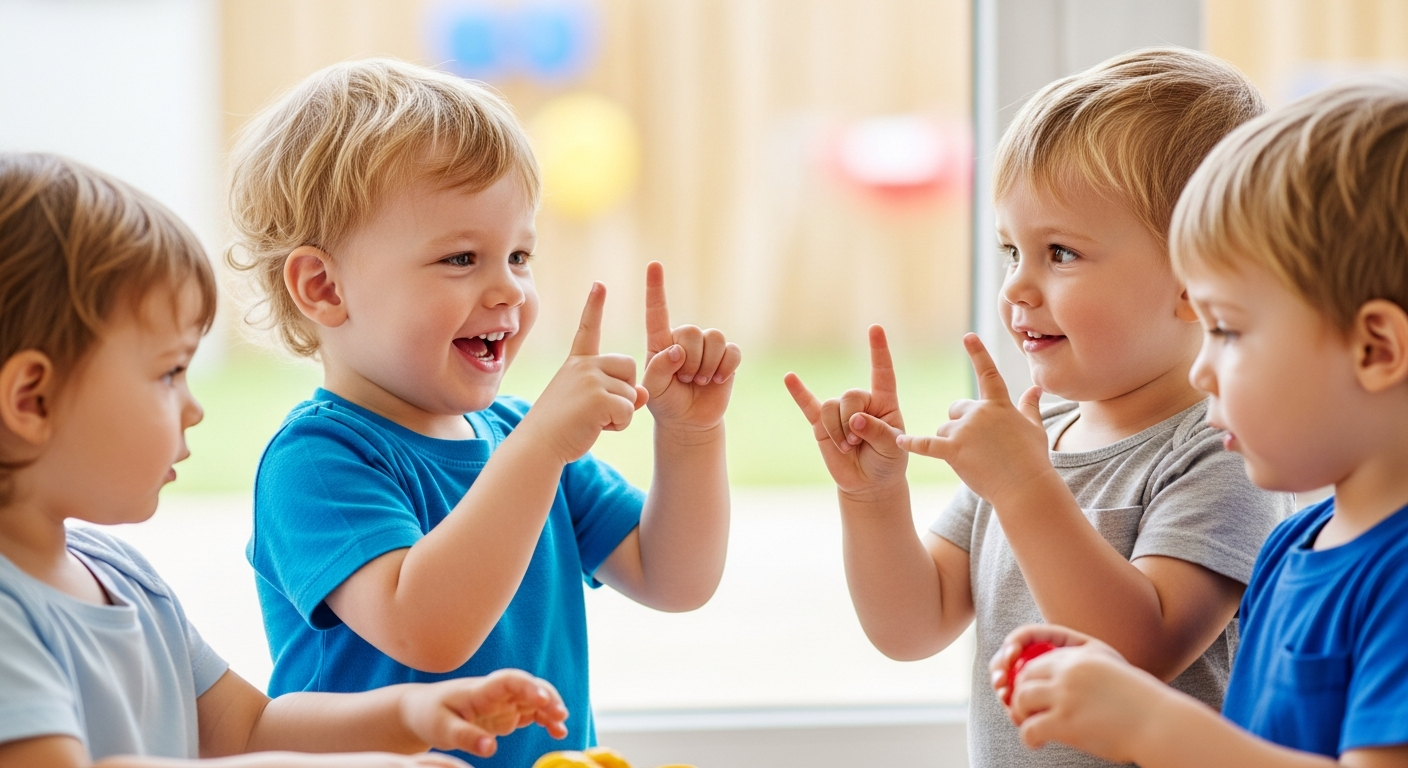
Table of Contents
- Introduction
- Why Sign Language Works for Speech Delays
- Debunking the Myths: Will Signing Stop My Child from Talking?
- The First 10 Functional Signs to Teach Your Toddler
- How to Teach Sign Language: The Speech Blubs Method
- Practical Scenarios: Connecting Play to Learning
- Speech Blubs: A Powerful Supplement to Therapy
- Choosing the Best Plan for Your Family
- Transitioning from Signs to Spoken Words
- The Psychological Impact on the Family
- Conclusion
- FAQs
Introduction
Imagine your two-year-old is standing in the kitchen, face turning red, pointing frantically at the counter and beginning to cry. You offer a cracker; they throw it. You offer juice; they scream louder. You feel helpless, and they feel unheard. This "communication breakdown" is a daily reality for the families of the 1 in 4 children who experience speech and language delays. At Speech Blubs, we understand this frustration deeply because our founders grew up with speech challenges themselves. They created the tool they wished they had—a way to turn that frustration into a moment of connection and joy.
One of the most effective, science-backed bridges to help these "late talkers" is something you might not expect: sign language. While it may seem counterintuitive to teach a child to use their hands when you want them to use their voice, sign language for toddlers with speech delay is actually a powerful catalyst for verbal communication. It isn't just about "quieting" the frustration; it’s about building the foundational cognitive pathways that eventually lead to spoken words.

In this comprehensive guide, we will explore why sign language is a vital tool for speech development, debunk common myths that keep parents from trying it, and provide practical, step-by-step strategies to integrate signing into your daily routine. We will also show you how our unique "smart screen time" approach can supplement this journey, helping your child find their voice through the power of peer observation and play. Our mission is to empower children to speak their minds and hearts, and often, that journey starts with a simple gesture.
Why Sign Language Works for Speech Delays
It is a common physiological fact that a child’s gross and fine motor skills—the ability to wave, point, and move their hands—develop much earlier than the complex coordination required for speech. To speak a single word, a child must coordinate their breath, vocal cords, tongue, lips, and jaw with millisecond precision. For a toddler with a speech delay, this physical "hardware" isn't quite ready, even though their "software"—their desire to communicate—is running at full speed.
The Bridge to Verbal Communication
Think of sign language as a bridge. On one side of the river, you have your child’s thoughts and needs. On the other side, you have spoken English. If the bridge of speech isn't built yet, the child gets stuck on the other side, leading to tantrums and withdrawal. Sign language acts as a temporary ferry. It allows the child to cross over and interact with you while the permanent bridge of speech is under construction.
When a child learns that making a specific hand movement (like "more") results in getting another slice of apple, they have learned the most important lesson in language: Communication is power. Once a child realizes they can influence their environment with a symbol, they become much more motivated to try the spoken version of that symbol.
The Science of "Smart" Learning
Our methodology at Speech Blubs is rooted in scientific research regarding how children learn. We utilize "video modeling," which leverages mirror neurons in the brain. When your child watches another child perform a sign or say a word, their brain fires as if they were doing it themselves.

Research consistently shows that using gestures and signs early on supports, rather than hinders, verbal development. In fact, children who sign often have larger vocabularies by age three than those who do not. If you are curious about where your child currently stands in their development, you can take our quick 3-minute preliminary screener. It consists of 9 simple questions and provides you with a personalized assessment and next-steps plan.
Debunking the Myths: Will Signing Stop My Child from Talking?
The number one concern parents share with us is: "If I give them an easy way to communicate with their hands, won't they just get lazy and never bother to speak?"
The answer, supported by decades of speech-language pathology, is a resounding no.
Human beings are naturally inclined toward the most efficient form of communication. Speaking is much faster and requires less physical effort than signing once the motor skills are present. Your child will not choose to sign for the rest of their life for the same reason they didn't choose to crawl for the rest of their life once they learned to walk—walking is simply more efficient.
Signing as a "Speech Booster"
Rather than replacing speech, sign language provides the "scaffolding" for it. It reduces the cognitive load. If a child doesn't have to struggle to find the physical mechanics of the word "milk," they can focus on the concept of "milk" and the social interaction of asking for it.
We see this frequently in our community. Parents often share testimonials about how their child’s first spoken words were actually preceded by months of signing. The sign gave them the confidence to try the sound. At Speech Blubs, we provide a "screen-free alternative" to passive viewing. Instead of your child zoning out to a cartoon, they are actively engaging in a "smart" experience where they see a peer sign a word, hear the word, and are encouraged to mirror the action.
The First 10 Functional Signs to Teach Your Toddler
When starting with sign language for toddlers with speech delay, the goal isn't to learn the entire dictionary. The goal is "functional communication"—words that give your child control over their daily life.
- More: Perhaps the most famous baby sign. It involves tapping the fingertips of both hands together. This is a "power word" that can be used for food, play, or attention.
- Eat: Bringing the tips of the fingers to the mouth. This immediately tells you when the "hangry" phase is approaching.
- Drink: Mimicking the motion of holding and tilting a cup toward the mouth.
- All Done: Twisting the hands back and forth with palms facing the child, then away. This is vital for ending a meal or an activity without a meltdown.
- Help: Placing one flat palm under the other hand, which is in a fist with the thumb up. This is a game-changer for reducing frustration during play.
- Please: Rubbing a flat palm in a circle on the chest. This introduces social-emotional learning early on.
- Milk: Squeezing the hands into a fist, like milking a cow.
- Stop: Bringing the edge of one hand down onto the flat palm of the other. Essential for safety and boundaries.
- Play: Extending the thumb and pinky finger (the "hang loose" sign) and shaking the hand.
- Bed: Placing both palms together and resting the head on them like a pillow.
For a parent whose 3-year-old "late talker" loves animals, incorporating signs for their favorite pets can be even more motivating. In our app, the "Animal Kingdom" section offers a fun, motivating way to practice "moo" and "baa" sounds alongside gestures. To begin this journey, you can Download Speech Blubs on the App Store or get it on Google Play.
How to Teach Sign Language: The Speech Blubs Method
Teaching signs shouldn't feel like a classroom lesson; it should feel like a game. Here is our recommended approach for parents:
1. Model the Sign with the Word
Never sign in silence. Your child needs to hear the auditory label while seeing the visual gesture. Every time you offer more water, say the word "More" clearly and perform the sign. This creates a multi-sensory map in their brain.
2. Use "Hand-over-Hand" Assistance
If your child is interested but can't quite get the finger placement right, gently place your hands over theirs and help them make the motion. Immediately follow this with the reward (the object or the action) and plenty of verbal praise.
3. Consistency is King
Use the same signs every single time. If you use "all done" at the dinner table, use it when you finish a book or when you're leaving the park. Repetition is how the brain locks in new skills.
4. Leverage Peer Modeling
This is where Speech Blubs truly shines. Children are naturally more interested in other children than in adults. When they see a "peer" on the screen making the sign for "Apple," they are much more likely to imitate it. This is the core of our "video modeling" methodology. We aren't just an app; we are a joyful solution that blends scientific principles with play.
Practical Scenarios: Connecting Play to Learning
Let’s look at how this works in a real-world setting.
The Bubble Scenario: Imagine you are playing with bubbles. Your child is mesmerized. You blow the bubbles, then close the jar.
- The Adult: Hold the jar and wait. Look at your child.
- The Action: Perform the sign for "More" or "Open."
- The Wait: Give them 5 to 10 seconds of "expectant waiting."
- The App Integration: Later that day, you can open the "Early Words" section of Speech Blubs. You find the video of a child signing "More." Your toddler sees the child on the screen, smiles, and mimics the gesture they practiced earlier. This reinforces the learning in a low-pressure, "smart screen time" environment.
The Snack Time Scenario: Your child wants a cracker that is out of reach.
- The Adult: Instead of just handing it over, sign "Please" or "Eat."
- The Response: If they make even a small gesture that resembles the sign, celebrate! "Yes! You want to eat! Here is your cracker."
- The Goal: You are rewarding the intent to communicate, which builds the confidence needed to eventually try the spoken word.
Speech Blubs: A Powerful Supplement to Therapy
While sign language is an incredible tool, many children benefit from a multi-pronged approach. Speech Blubs is designed to be a powerful supplement to professional therapy and your overall development plan. We provide an immediate, effective way to work on communication skills at home.
Unlike passive cartoons that can lead to "zoning out," our content is interactive. We use the front-facing camera (with your permission) to create a "mirror" effect, where your child can see themselves alongside their peers. This boosts self-awareness and makes the learning process joyful.
We are committed to being a tool for family connection. The best way to use the app is "co-play"—sitting with your child, mirroring the signs together, and laughing at the fun filters. This creates a positive emotional association with learning, which is the most effective way to ensure long-term progress.
Choosing the Best Plan for Your Family
We believe in transparency and providing the best possible value for our families. We offer two main paths to help your child "speak their mind and heart":
- The Monthly Plan: At $14.99 per month, this is a great way to test the waters.
- The Yearly Plan (Best Value): At $59.99 per year, this breaks down to just $4.99 per month.
We highly recommend the Yearly Plan because it is designed for a long-term developmental journey. Speech delay isn't solved overnight; it’s a process of building blocks. The Yearly Plan includes:
- A 7-day free trial so you can explore all features risk-free.
- Access to our Reading Blubs app, which helps transition your child from words to literacy.
- Early access to all new updates and content.
- Priority 24-hour support response time.
The Monthly plan does not include these exclusive, high-value features. If you're ready to start, you can create your account and begin your free trial on our web page.
Transitioning from Signs to Spoken Words
The ultimate goal for most parents is to hear their child’s voice. As your child becomes proficient at signing, you will naturally start to see them "mouth" the words or make an initial sound (like saying "m" while signing "more").
Don't Drop the Signs Too Early
A common mistake is to stop signing the moment the child says their first word. Keep signing! Use the sign as a safety net. If your child tries to say "water" and you don't understand them, they can "fall back" on the sign to clarify. This prevents the frustration that leads to them giving up on verbal speech.
Focus on Confidence, Not Perfection
We never want a child to feel "tested." If they say "ba" for "ball," celebrate it as if they just gave a Shakespearean monologue. Confidence is the fuel for language development. Our app's "peer-to-peer" approach helps reduce the pressure. When they see a child their age making a sound, it feels attainable. It feels like play, not a chore.
"Our mission is to provide an immediate, effective, and joyful solution for the 1 in 4 children who need speech support, blending scientific principles with play into one-of-a-kind 'smart screen time' experiences."
The Psychological Impact on the Family
A speech delay doesn't just affect the child; it affects the parents. The stress of not knowing what your child wants can be overwhelming. By introducing sign language for toddlers with speech delay, you are giving yourself a tool as well.
When the communication barrier begins to crumble, the entire household dynamic changes. There are fewer tantrums, more smiles, and a deeper sense of connection. You stop being a "detective" trying to solve the mystery of a crying child and start being a "partner" in their discovery of the world.
Our homepage is full of resources to help you understand this journey. We are here to support you with empathetic expertise every step of the way.
Conclusion
Sign language is not a "crutch" for a child with a speech delay; it is a springboard. By providing a visual and physical way to communicate, you are reducing your child’s frustration, boosting their cognitive development, and building a foundation for future verbal success. Whether your child uses signs for a few months or a few years, the goal remains the same: helping them feel heard, understood, and confident.
At Speech Blubs, we are honored to be a part of this journey with you. We invite you to join our community of over 5 million parents who have discovered the joy of "smart screen time." Our video modeling methodology, backed by science and created by people who truly understand speech challenges, is ready to help your child thrive.
Ready to get started? We recommend choosing our Yearly plan to get the full suite of features, including the Reading Blubs app and early access to updates. Download Speech Blubs on the App Store or Google Play to begin your 7-day free trial today. Let's help your child speak their mind and heart, one sign and one word at a time.
FAQs
1. Will signing make my child a "lazy" talker?
Absolutely not. Research shows that sign language actually encourages verbal speech. Speech requires complex fine motor control that develops after the ability to use hand gestures. Signing gives children a "success" in communication, which motivates them to try spoken words as their physical development catches up.
2. When is the best age to start teaching sign language?
You can start as early as 6 to 9 months, but it is never too late. For toddlers with a speech delay, starting now—regardless of their age—can provide an immediate way to reduce frustration. Most children have the motor coordination to begin signing back around 10 to 12 months.
3. Do I need to learn American Sign Language (ASL) perfectly?
No. While using standard ASL signs is helpful (it makes it easier for other caregivers to understand them), the most important thing is consistency. If your child creates their own "home sign" for something and you both understand it, that is still a successful communication moment.
4. How does the Speech Blubs app help with signing?
Speech Blubs uses a "video modeling" technique where your child watches other children (their peers) perform signs and say words. This triggers mirror neurons in your child’s brain, making them much more likely to imitate the behavior than if they were watching an adult or a cartoon character.
About the author